
Yila
Yila supports scholarly discovery, reading and writing, with research workflows for documents and presentations.
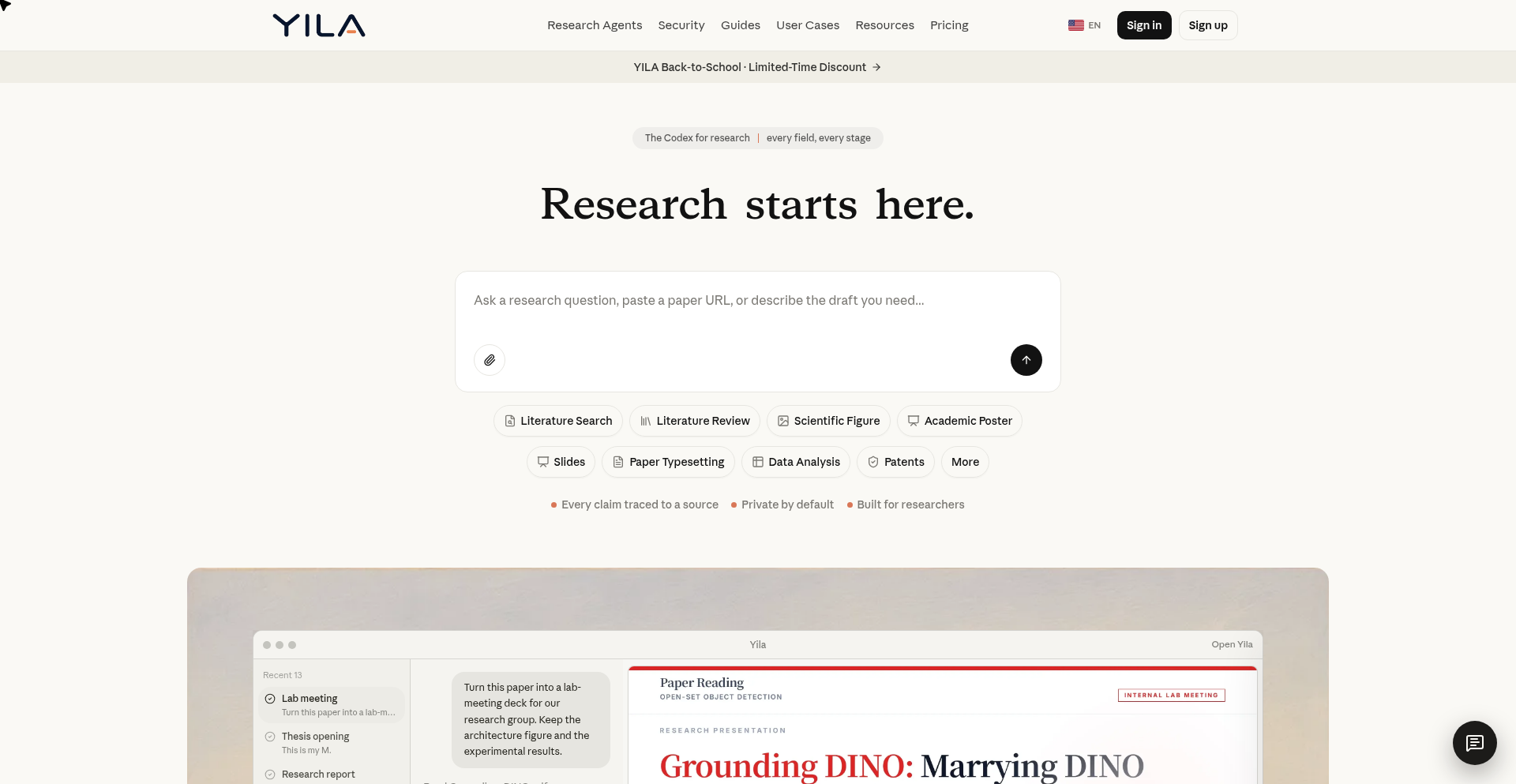
Yila is an AI research assistant for work involving scholarly publications. Its documented workflows connect literature discovery, reading, review writing and preparation of documents and presentations. Researchers can use the service to engage with material around an inquiry, while they remain responsible for checking the resulting explanation against the sources. Yila is paid. The official website provides current access information, and this product-team description does not claim a free allowance, a fixed price or a measured advantage over another service.
A literature review benefits from a clear question. Decide which issue the work will address and what kinds of evidence could help answer it before collecting sources. A result that mentions a topic does not necessarily support the conclusion a researcher expects to write. An AI research assistant can participate in discovery, while the person defines relevance and examines the original material. This introduction does not promise coverage of every scholarly database or guarantee that all important publications will be found.
Paper reading supplies context for those decisions. A source may examine a narrow question, use particular methods or state qualifications that affect how its findings can be described. Inspect those features before relying on a brief overview. Yila documents reading workflows, but generated language is not an independent research result. Compare important claims with the publication itself. If the original material is unavailable, acknowledge that limit rather than inventing a method, quotation or finding to fill the gap.
During a literature review, comparison also needs care. Sources can discuss related ideas while studying different settings or measuring different outcomes. Explain those differences when they affect the argument. An AI research assistant can take part in organizing and writing about the material, while the researcher judges whether a proposed comparison fairly represents the sources. This listing does not invent a validated automatic evidence-grading system or claim that disagreements between publications will be resolved correctly without further examination.
A hypothetical inquiry into a teaching practice illustrates a possible workflow. A researcher might discover related publications and use paper reading to examine what each actually establishes. The next decision is whether those findings address the intended question and how their limits should be presented. This is an example of a task someone could assess with the documented workflows. It is not a completed customer case, an institutional recommendation or a claim about the effectiveness of a particular educational practice.
Writing develops an explanation that another reader can inspect. A literature review should connect the question with its evidence, while making the strength and scope of the conclusions clear. An AI research assistant can participate in the documented writing workflow, but the author needs to check attributed claims and citations against the intended publications. Fluent prose does not prove that a reference exists or that it supports the statement made about it. Revision should improve that connection rather than hide uncertainty.
Document and presentation preparation provide further documented workflows. A researcher may need an editable account of the inquiry or a presentation that communicates its central claims to an audience. Paper reading can inform decisions about what context to preserve and what details deserve emphasis. This introduction does not assert compatibility with every citation manager, publisher template or output format. It also does not invent collaboration controls, audience-analysis features or guarantees that the resulting material meets a particular institution's requirements.
Yila's scope connects discovery, source engagement, writing and preparation of research material. Someone considering an AI research assistant can consult the official root website, check current conditions and assess the workflows against a manageable task. A literature review remains dependent on careful source evaluation and appropriate author judgement. This description supplies factual product orientation without manufacturing studies, user ratings, measured time savings or an independent endorsement. Final material should be selected, checked and revised according to its actual purpose.
Key features
- 01Literature discovery
- 02Paper reading workflows
- 03Review writing
- 04Document preparation
- 05Presentation preparation
Screenshots
Reviews
Phyco does not write or buy reviews - be the first. A free account takes a minute: one account, one review, confirmed email.
Sign in or sign upSimilar listings
More Education & Learning → Tử Vi Phương ĐôngEducation & Learning
Vietnamese tools for Tu Vi charts, feng shui home directions and I Ching learning.
 AI Sales TrainingEducation & Learning
Compare AI courses for practical sales work.
 Clear Focus ToolsEducation & Learning
Free cognitive games with transparent task-level results
 SmartDevoir AIEducation & Learning
Guided AI learning, revision, quizzes and study planning
 Grok Bot WikiEducation & Learning
Independent Grok Bot directory with community templates and source-linked guides.
 AIforJrEducation & Learning
AI tutor for kids ages 4-11